


Prof.Prem Kumar Khatry, Ph. D.
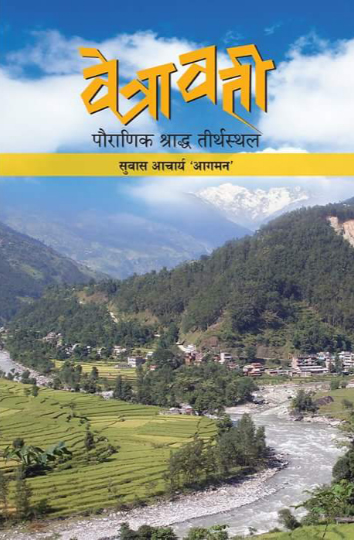
It has been quite some time since the writer Subash Acharya ‘Agaman’ made a sudden appearance in my small home-made library at Gongabu, Kathmandu, and extended his hands of friendship. In him I found a friendly, hardworking intellectual and a promoter of tourism and culture in Nepal and several other cultural landmarks in that part of the Himalayan range. It is thus a pleasure to review his second and equally important work on UttarGaya Betrawati, a popular pilgrimage of Hindus in Nepal.
SubashAgaman’s words of wisdom expressed through this text is not only worth reading but warrant serious thoughts and appreciation from an expected wide range of readers. These words that have found expression in this work entitled: Uttar Gaya Betrawati, PuranictathaShraddhaTirthasthal (a pilgrimage for ancestor worship) are worth following from the first to the last page. They flow like the holy waters of Betrawati sprinkling the feeling of being next to the holy river, the pilgrimage discussed in the book. Once started, there is no return or stop till you finish at least a chapter and start the next. Or, that is how I did the reading myself and was drenched not only by the words or pages, but by the feeling of trust and respect showered toward the holiness of the place, the serene nature and the lucky people inhabiting the river courses flanked by the lovely terraced fields and lush green forests.
I strongly feel and believe the writer has done tremendous justice to his native place he so loves, adores and derives aspiration from. Each page of the book is a testimony of the motherly love and respect to the place–the Holy UttarGaya, Betrawati. There is another parallel he draws–the mother-son bond and the serene wish of his mother, Radhika Acharya, that he must finish the writing on time because this is a holy work. In fact, not only the people of Rasuwa but people from far and near to this place regard Betrawati-UttarGaya with honor and respect. This is a place to gather as pilgrims and worship our ancestors, remember and feel them sitting next to us, and receive their blessing as well as energy to live and to work. UttarGaya, the Gaya of the North, has thus been a source of blessing and freedom from Deva and Pitr-rna (divine and paternal debt) for a long time. For the Hindu believers a pitr-shraddha (post-death rites for the ancestors) is a must to be free from the Rna (the debt). And, performing this shraddhaat a proper and recommended place like UttarGaya is a means to attain merit in life.
The importance of Holy UttarGaya as a place of pilgrimage in the name of the ancestors is very meaningful. Dutiful sons and family members of the deceased see to it that they visit Gaya in Bihar, India, and UttarGaya in Rasuwa, Nepal, to fulfill their duty and responsibility towards the deceased whose Soul (atma) completes the long and arduous journey to finally unite itself with the Supreme Soul (praramatma). There will be no life-cycle of ‘birth and death’ for an emancipated Soul. The holy pilgrimage of UttarGaya is a place to realize this status.
In order to describe the importance of this holy place, the writer cites mantras from several shastrapramana (textual evidences). His arguments and narration from the puranas are convincing and worth recitation at the same time. The reader surely needs a bit of understanding of Sanskrit to grasp the meaning of the shastras but with the translation forwarded by the writer, it is not at all difficult to enrich the store of knowledge on the history of the Himalayan pilgrimage in general and Betrawati-UttarGaya in particular.
The writer rightly claims the holy site of Betrawati has a long and continuous history in the Hindu spiritual world. Several puranas explain the importance of this site for the Hindu as well the non-Hindu dwellers. The site is also a link among many other sites whose names and fame are associated with Lord Shiva and His spouse Parvati, the daughter of the Himalaya. Several stories are collected by the writer to prove the antiquity of the site and the influence it has on the mind and heart of the people dwelling this Himalayan terrain for the time immemorial.
The name of Betrawati came into prominence during and after the short but serious Nepal-Bhot War. It is said, the Nepali side had almost giving up to the encroachers but then a sudden miracle happened at Betrawati. The Tibetan forces experienced a deep psychological scar in their heart and made immediate decision to withdraw. People still believe the entire force became a victim of sudden depression due to the prolonged warwith their invincible enemy, the Nepalese Army and the curse of the local deities. Betrawati, people believe, is a spiritual power-place to reckon with.
The book is based on research and therefore readable. His collection of historic documents also makes this rich as well as interesting. Towards the end of the text he puts forward his arguments to make this place a noted pilgrimage. With some additional facilities for the pilgrims this can happen. The government can also invest in it as a gesture of goodwill and support for the local plans to promote culture and tourism at the same time.
Finally, Subashji has done a great job to promote the holy name of UttarGaya through his research and presentation. He thus deserves congratulations. The book is worth collection and reading. At a time when culture studies have shown a declining trend, books such as this can help reverse the trend.
I wish the writer a success and hope the readers will find this book not only interesting to read but as an invitation to visit the sites herein described. While writing these lines, I myself experienced as if I was visiting Betrawati-Uttar Gaya. And, of course, a real visit will take place sooner than later.
Prem Kumar Khatry, Ph. D.
Former Director
Centre for Nepal and Asian Studies (CNAS)
Tribhuvan University